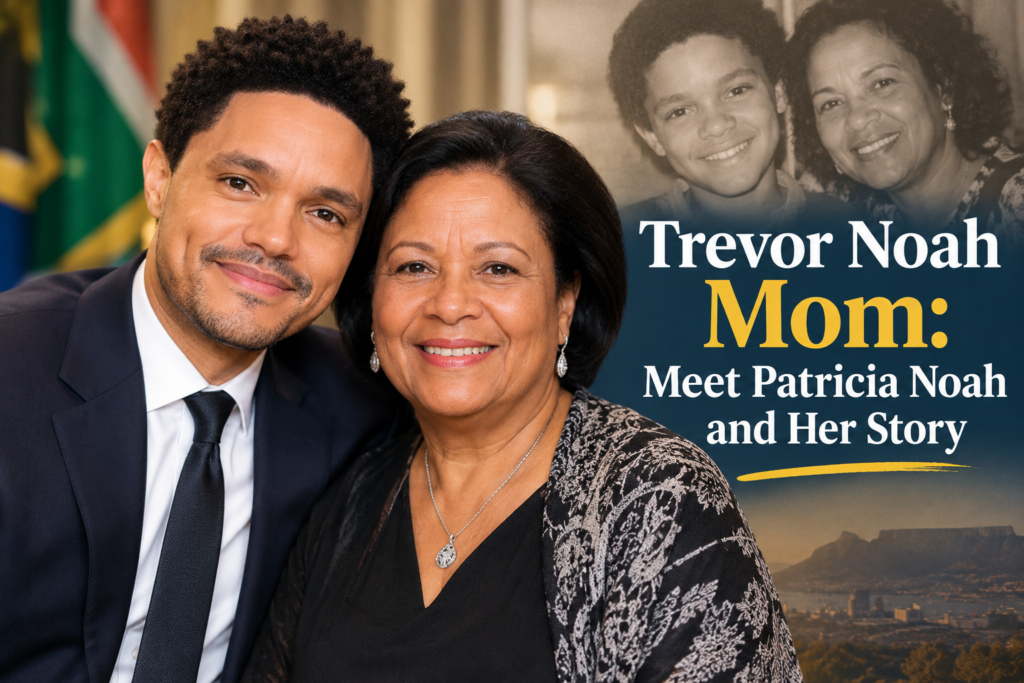

When people learn about Trevor Noah’s childhood, they often want to understand the woman who helped shape his personality, humor, and outlook on life. Trevor Noah mom, Patricia Noah, is an important part of his personal story. As a Black South African woman raising a child during apartheid, she faced social restrictions, discrimination, and difficult circumstances that influenced their family life. Her experiences also help explain why Trevor frequently discusses race, identity, freedom, and resilience in his comedy and writing.
Patricia Noah was more than the mother of a future international comedian and television host. She was an independent-minded woman who made difficult decisions to give her son opportunities that apartheid-era South Africa often denied people from mixed-race families. Her determination, sense of humor, and commitment to independence became important influences on Trevor’s upbringing.
In this article, you will learn who Patricia Noah is, how she raised Trevor, what life was like for their family under apartheid, and why their relationship remains such a meaningful part of his public story. Understanding her background offers a deeper perspective on Trevor Noah’s journey from Johannesburg to international recognition.
Who Is Trevor Noah’s Mom, Patricia Noah?
Trevor Noah’s mother is Patricia Nombuyiselo Noah, a South African woman of Xhosa heritage who became widely known through her son’s memoir, Born a Crime: Stories from a South African Childhood. She played a central role in his upbringing and is frequently described by Trevor as one of the most influential people in his life. assets.penguinrandomhouse.com+1
Patricia raised Trevor in a society where racial segregation shaped almost every aspect of everyday life. Her relationship with a white man, Robert Noah, challenged the laws and social expectations of apartheid-era South Africa.
Rather than accepting the restrictions placed on her, Patricia pursued independence, worked to support herself, and made education a priority for her son. She also encouraged him to think critically, adapt to different environments, and understand people beyond the boundaries imposed by race.
Her personality combined determination, religious faith, humor, and a strong sense of personal responsibility. These characteristics feature prominently in Trevor’s recollections of his childhood.
Although the public knows Patricia primarily through her son’s career, her story stands independently as an example of a woman navigating an unequal society while trying to create better opportunities for her child.
Patricia Noah’s Early Life and Background
Patricia Noah grew up in South Africa during a period when apartheid policies restricted the rights, movement, and opportunities of Black South Africans. Her experiences influenced her determination to build an independent life.
According to accounts of her life in Trevor’s memoir, she left home while young and pursued work and education despite the obstacles facing Black women. She eventually trained for secretarial work, a path that represented a significant step toward financial independence. LitCharts+1
Her determination to become independent
Patricia did not want her future to be entirely determined by the circumstances into which she was born. She sought employment, made decisions for herself, and challenged expectations about what a Black woman could accomplish.
Her story illustrates an important distinction: independence was not simply a personal preference in apartheid South Africa. It could require navigating racial restrictions, unequal access to employment, and social pressure.
Her determination later influenced the way she raised Trevor. She wanted him to understand that circumstances could create obstacles without necessarily defining the limits of his ambitions.
Her cultural and religious values
Patricia’s Xhosa background and Christian faith were important parts of family life. Trevor has described a childhood in which religion played a prominent role, including regular visits to church.
For Patricia, faith was not merely a private belief. It formed part of how she approached difficulties and encouraged her son to think about morality, responsibility, and his relationship with other people.
Her approach also demonstrates that strong parenting can involve more than providing material necessities. Values, discipline, curiosity, and a willingness to challenge unfair rules can influence how a child understands the world.
Trevor Noah’s Childhood Under Apartheid
Trevor Noah was born on February 20, 1984, in Johannesburg, South Africa. His mother was Black, and his father, Robert Noah, was a white Swiss man. Their relationship existed during apartheid, when South African law prohibited sexual relationships between people classified as belonging to different racial groups. The Washington Post+1
The circumstances of Trevor’s birth explain the title of his memoir, Born a Crime.
Why Trevor’s birth was legally complicated
Apartheid was a system of institutionalized racial segregation that classified people according to race and imposed different rights and restrictions on different groups.
The Immorality Act prohibited interracial sexual relationships. As a result, Patricia and Robert faced legal and social risks because of their relationship.
Trevor’s existence challenged the racial categories that the government attempted to enforce. His mother therefore had to take precautions to protect him from the consequences of a system that treated his family as a problem.
How Patricia protected her son
During Trevor’s early childhood, his mother sometimes had to conceal their relationship in public. In certain situations, she could not openly behave as his mother without risking unwanted attention from authorities.
Trevor also spent time with his maternal grandmother and other relatives. These arrangements were part of the family’s efforts to navigate a society in which a child’s appearance and family background could create serious complications.
Patricia’s decisions show how political systems can affect ordinary family routines. Activities that many parents take for granted, such as walking together in public, were not always straightforward for Trevor and his mother.
Apartheid ended as a governing system in the early 1990s, and South Africa’s first democratic election took place in 1994. Trevor was approximately ten years old when the country reached that historic turning point. The Washington Post+1
How Patricia Noah Influenced Trevor’s Success
Patricia’s influence on Trevor extended beyond protecting him during childhood. She helped develop his curiosity, independence, adaptability, and ability to understand people from different backgrounds.
Trevor has spoken publicly about recognizing his mother’s importance more deeply while writing Born a Crime. He came to see her as the central hero of his personal story rather than viewing his own achievements in isolation. WBEZ Chicago+1
1. She encouraged education and curiosity
Patricia placed considerable importance on her son’s education. She wanted him to gain knowledge and opportunities that could help him navigate a world shaped by inequality.
Education, in this context, meant more than attending school. It also included learning about society, asking questions, and developing the ability to understand situations from different perspectives.
For parents today, this offers a useful lesson: encouraging children to become curious and independent thinkers can be just as valuable as helping them achieve good grades.
2. She taught him to adapt to different environments
Trevor grew up navigating communities with different racial identities, languages, and social expectations. His mother encouraged him to recognize that people could have very different experiences of the same society.
This background later became useful in comedy, where observing social differences and understanding conflicting perspectives are important skills.
It would be an oversimplification to credit every part of Trevor’s career to his mother alone. His own work, talent, and professional opportunities also mattered. Nevertheless, his upbringing provided experiences that helped shape his perspective.
3. She combined discipline with humor
Patricia’s parenting style was not always gentle. Trevor’s memoir describes strict discipline and some troubling childhood experiences, alongside warmth, humor, and affection.
This complexity matters because real family relationships are rarely captured accurately by describing a parent as either perfect or entirely flawed.
Trevor’s stories portray a mother who could be demanding and unconventional while remaining deeply committed to her son’s future. His ability to find humor in difficult experiences also reflects the way his family navigated challenging circumstances.
A key insight: Patricia’s influence is best understood not as a simple formula for success but as a combination of protection, expectations, education, and exposure to a complicated world.
Patricia Noah’s Relationship With Robert Noah
Robert Noah, Trevor’s father, was a white Swiss man who lived in South Africa. Patricia and Robert had Trevor despite the restrictions imposed on interracial relationships under apartheid. They did not marry. TIME+1
Because of the political and social environment, Trevor’s relationship with his father was different from the experience of children whose parents could live openly together.
Robert remained part of Trevor’s life, although contact was limited during parts of his childhood. Trevor later reconnected with his father as an adult.
Patricia’s relationship with Robert is significant because it reveals the personal consequences of discriminatory laws. The restrictions were not abstract political rules: they affected where families could live, how parents could interact with their children, and whether relationships could be acknowledged publicly.
Their story also helps explain why Trevor developed such a strong interest in identity and belonging. He grew up with a family background that did not fit neatly into the racial categories enforced by the society around him.
Patricia Noah’s Marriage to Abel and a Difficult Family Chapter
After her relationship with Robert, Patricia married Abel, a mechanic who became Trevor’s stepfather. They had two sons, Andrew and Isaac, Trevor’s half-brothers.
Trevor’s memoir describes the deterioration of Patricia and Abel’s relationship, including domestic abuse. This became one of the most painful parts of the family’s history. Biography+1
The shooting incident
In 2009, after Patricia had left Abel, he shot her. She survived the attack, although the incident caused serious physical and emotional trauma for the family.
Trevor has discussed the event publicly and described the shock, anger, and confusion he experienced. The incident also brought attention to the danger of domestic violence and the difficulties victims can face when attempting to leave abusive relationships. Biography+1
It is important not to reduce this experience to a dramatic detail in a celebrity biography. Domestic abuse can have lasting consequences for victims and their families, and responsibility for violence rests with the person who commits it.
Patricia’s survival became another defining part of her family’s story. Trevor’s later reflections also show how difficult it can be to process violence while trying to preserve one’s own emotional well-being.
What Is Born a Crime About?
Born a Crime: Stories from a South African Childhood is Trevor Noah’s memoir about growing up during apartheid and the years that followed. Published in 2016, it combines personal stories with reflections on race, family, poverty, identity, and South African society. assets.penguinrandomhouse.com+1
Patricia is central to the book. Many of its most memorable experiences involve her choices, her unconventional parenting, and the risks she took to provide Trevor with a broader future.
The memoir also explores difficult subjects, including family conflict and discrimination, without presenting childhood as entirely tragic. Humor helps Trevor explain the absurdity of some situations while showing how people find ways to cope with hardship.
Why the memoir matters
Readers interested in Patricia Noah may find the book especially valuable because it provides a detailed account of their relationship from Trevor’s perspective.
It also offers historical context for readers who did not grow up in South Africa. The family stories illustrate how apartheid affected personal decisions, education, employment, relationships, and everyday movement.
One important distinction is that a memoir presents an author’s recollections and interpretation of events. It can provide meaningful personal insight, but it should not automatically be treated as a complete account of every person’s perspective.
What Can Parents Learn From Patricia Noah’s Story?
Patricia’s experiences offer several practical lessons, although her circumstances were unusually difficult and cannot be directly compared with every modern family situation.
Encourage children to think independently
Children benefit from learning how to ask questions, assess information, and form thoughtful opinions. Patricia’s determination to think beyond society’s expectations helped shape Trevor’s independent outlook.
Parents can encourage these skills by discussing everyday decisions, allowing age-appropriate independence, and explaining why rules exist rather than relying entirely on authority.
Make education about more than grades
Education can include reading, cultural awareness, communication, and learning how other people experience the world.
Patricia’s influence demonstrates the value of broadening a child’s understanding beyond their immediate surroundings.
Recognize resilience without romanticizing hardship
Patricia showed extraordinary determination in difficult circumstances. However, that does not mean discrimination, poverty, or domestic violence are necessary for personal growth.
The more useful lesson is that people deserve support and opportunities to build secure lives, especially when they face obstacles outside their control.
Understand family relationships in their full complexity
Patricia was a major source of love and encouragement in Trevor’s life, but their relationship also included strict discipline and difficult experiences.
Acknowledging both sides gives readers a more realistic understanding of parenting. Admiration does not require pretending that every decision was perfect.
FAQs About Trevor Noah’s Mom
1. What is Trevor Noah’s mom’s name?
Trevor Noah’s mother is Patricia Nombuyiselo Noah. She is a South African woman of Xhosa heritage who raised Trevor during apartheid and played a major role in shaping his values and outlook. Her story is featured prominently in his memoir, Born a Crime.
2. Is Trevor Noah’s mom still alive?
Public accounts have described Patricia Noah as surviving the 2009 shooting committed by her former husband, Abel. However, her current status has not been independently verified here. Readers should be cautious about treating unconfirmed social media claims or outdated biographical pages as proof of recent developments.
3. Why was Trevor Noah’s birth considered a crime?
Trevor was born in 1984 to a Black South African mother and a white Swiss father. Under apartheid, the Immorality Act prohibited interracial sexual relationships, placing his parents at legal risk. His memoir uses the phrase Born a Crime to describe the circumstances surrounding his birth.
4. What happened to Trevor Noah’s mother and stepfather?
Trevor’s mother, Patricia, married Abel, who later became abusive. After she left him, he shot her in 2009, but she survived. Trevor has discussed this traumatic incident in public accounts of his family’s history.
5. Did Patricia Noah influence Trevor’s career?
Yes, Patricia significantly influenced Trevor’s upbringing, education, independence, and understanding of different communities. These experiences helped shape his perspective as a comedian and writer. His career success also reflects his own abilities, work, and professional opportunities.
6. What book tells the story of Trevor Noah’s mother?
Trevor’s memoir, Born a Crime: Stories from a South African Childhood, provides the most detailed public account of his relationship with Patricia. It explores their family life, the effects of apartheid, and the experiences that influenced his development. The book combines humor with serious reflections on identity, discrimination, and resilience.
Conclusion
Trevor Noah’s mother, Patricia Nombuyiselo Noah, is an important figure in understanding the comedian’s childhood, values, and personal development. Her determination to raise her son under apartheid, her commitment to education, and her willingness to challenge social expectations helped shape his understanding of the world.
Her story also includes painful experiences, including domestic violence, that reveal the complexity of her family’s journey. Rather than presenting Patricia as a flawless hero, Trevor’s recollections show a determined and complicated person whose influence remained significant throughout his life.
For readers seeking to understand Trevor Noah beyond his public career, Patricia’s story provides essential context. The most meaningful takeaway is that family influence often extends far beyond financial support or conventional definitions of success. Encouragement, independence, education, and the courage to question unfair systems can leave a lasting mark on a child’s life.