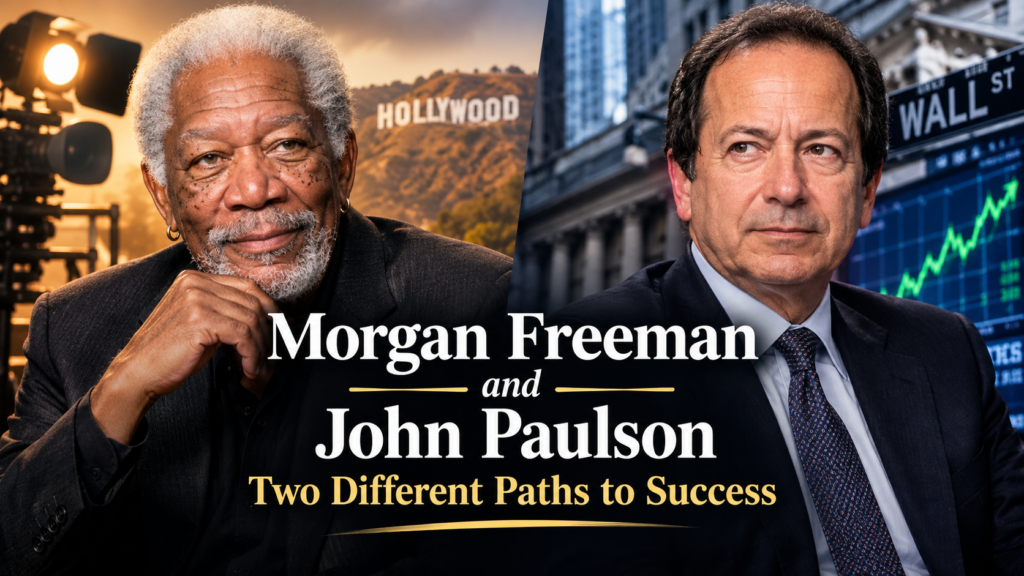

When people achieve extraordinary success, it is natural to wonder whether they share similar qualities, experiences, or decisions that helped them reach the top. The stories of Morgan Freeman and John Paulson offer an interesting comparison because they built their reputations in completely different industries. Freeman became one of Hollywood’s most recognizable actors, while Paulson established himself as a prominent hedge fund manager in the world of finance.
Although Morgan Freeman and John Paulson are known for different professional accomplishments, both demonstrate how specialized knowledge, persistence, and strategic decision-making can shape a successful career. Their experiences also reveal an important distinction: success in entertainment often depends on artistic ability, audience connection, and professional longevity, whereas success in investment management relies heavily on financial analysis, risk assessment, and market judgment.
Understanding their backgrounds helps explain why these two names occasionally attract interest from people researching celebrities, wealthy individuals, business leaders, and professional achievement. This article explores their careers, financial reputations, major accomplishments, and the lessons readers can draw from their very different journeys. It also clarifies what can reasonably be compared between them and why their individual achievements should not be reduced to a simple contest over wealth or fame.
Who Is Morgan Freeman?
Morgan Freeman is an American actor and narrator celebrated for his distinctive voice, commanding screen presence, and decades-long career. Born on June 1, 1937, in Memphis, Tennessee, he developed into one of the most respected performers in American cinema.
Freeman did not become a major Hollywood star overnight. His professional journey included theater, television, and smaller film roles before he achieved widespread recognition. His breakthrough in the film Street Smart brought significant attention to his acting, and his performance earned him an Academy Award nomination for Best Supporting Actor.
He subsequently appeared in acclaimed productions, including Driving Miss Daisy, The Shawshank Redemption, Se7en, Million Dollar Baby, and Invictus. His portrayal of Eddie Scrap-Iron Dupris in Million Dollar Baby earned him the Academy Award for Best Supporting Actor in 2005.
Freeman is also widely recognized for narration and documentary work. His voice has become associated with thoughtful storytelling, authority, and emotional depth. These qualities have helped him establish a professional identity that extends beyond conventional acting roles.
Why Morgan Freeman Remains Influential
Freeman’s career demonstrates the value of longevity and versatility. Rather than relying on one type of character, he has worked across drama, comedy, thrillers, historical films, and documentaries.
Several factors help explain his lasting appeal:
- Consistency: He continued developing his craft across different stages of his career.
- Versatility: He demonstrated an ability to portray a wide range of characters.
- Recognition: His performances earned major industry awards and nominations.
- Distinctive identity: His delivery and screen presence made him recognizable to audiences worldwide.
His professional history also challenges the assumption that success must arrive early. Freeman’s rise to major recognition came after years of work, illustrating how experience can become an advantage rather than a limitation.
Who Is John Paulson?
John Paulson is an American investor and hedge fund manager best known for his role in the financial markets during the 2007–2008 housing crisis. Born on December 14, 1955, in Queens, New York City, he pursued an education that prepared him for a career in business and investment management.
Paulson studied finance and later earned an MBA from Harvard Business School. He worked in the financial industry before founding Paulson & Co. in 1994, an investment management firm that became known for pursuing opportunities across different market conditions.
His most famous achievement came from betting against the US housing market before the financial crisis. Through investment strategies involving mortgage-related securities and credit derivatives, his firm positioned itself to benefit when the housing market deteriorated.
The trade became one of the most widely discussed examples of a successful investment during the crisis. However, understanding the accomplishment requires more than knowing that Paulson made a profitable bet. It involved identifying vulnerabilities in mortgage lending, evaluating complex financial instruments, and taking positions that depended on a market downturn.
Why John Paulson Became Famous in Finance
Paulson’s reputation rests largely on his ability to recognize a major financial risk before it became widely apparent to the market.
His career illustrates several characteristics of institutional investing:
- Research: Understanding the assets behind an investment rather than relying only on market sentiment.
- Risk analysis: Evaluating what could happen if economic conditions changed.
- Timing: Establishing positions before the expected event unfolded.
- Conviction: Maintaining an investment thesis despite uncertainty and potential losses.
Nevertheless, his most famous trade should not be interpreted as proof that predicting market crashes is easy. Financial markets are uncertain, and strategies that succeed in one crisis may fail under different conditions.
Morgan Freeman and John Paulson: What Do They Have in Common?
At first glance, Morgan Freeman and John Paulson appear to have little in common. One built a career through acting and storytelling, while the other became known for investment management. Yet comparing their professional journeys reveals several useful themes.
1. Both Built Specialized Expertise
Freeman developed the skills required to deliver convincing performances, understand characters, and communicate emotion. Paulson built expertise in financial analysis, investment strategy, and market behavior.
Their careers demonstrate that professional recognition generally requires more than public visibility. A recognizable name may attract attention, but sustained achievement depends on the underlying skills that make a person valuable in their field.
2. Both Worked Toward Long-Term Professional Recognition
Neither career can be understood solely through one moment of success. Freeman’s reputation developed through decades of performances, while Paulson’s standing in finance emerged from years of investment experience and the visibility of his crisis-era trade.
This distinction matters for readers evaluating successful people. A headline-making achievement can explain why someone became famous, but it rarely captures the complete process behind that achievement.
3. Both Faced Uncertainty
Actors cannot control every aspect of their careers. Film projects may underperform, roles may be limited, and audience preferences can change. Investors face a different form of uncertainty, including unexpected economic events, changing interest rates, and losses arising from incorrect assumptions.
The useful comparison is not that their risks are identical. It is that both professions require decisions under conditions where outcomes cannot be guaranteed.
Comparing Their Careers, Achievements, and Public Profiles
The most meaningful way to compare Freeman and Paulson is to examine what each person is known for rather than assume that their accomplishments are interchangeable.
| Category | Morgan Freeman | John Paulson |
|---|---|---|
| Primary field | Acting and narration | Investment management |
| Main source of professional recognition | Film performances and narration | Hedge fund management and investment decisions |
| Notable achievement | Academy Award for Million Dollar Baby | Profitable positioning against the US housing market before the financial crisis |
| Core professional skills | Acting, interpretation, communication | Financial analysis, valuation, risk management |
| Public reputation | Acclaimed actor and narrator | Prominent investor and hedge fund manager |
| Main lesson | Develop a lasting professional craft | Research risk and evaluate opportunities carefully |
The comparison highlights an important point: their professional success is measured in different ways. Freeman’s career is assessed through performances, awards, cultural influence, and continued audience interest. Paulson’s career is evaluated through investment outcomes, assets managed, financial decisions, and business performance.
Neither set of measures provides a complete account of a person’s life, and a direct comparison should acknowledge those differences.
Morgan Freeman and John Paulson Net Worth: What Is Known?
People searching for Morgan Freeman and John Paulson often want to know which individual has the greater net worth. This question is understandable, but it requires caution because personal wealth estimates are not the same as audited financial statements.
Morgan Freeman’s Wealth
Freeman’s wealth is associated with his extensive acting career, narration work, production activities, and other professional ventures. An established actor can earn income from film salaries, television appearances, commercial work, and projects that may generate additional payments over time.
However, the financial details of many private contracts are not publicly disclosed. His total assets, liabilities, taxes, investment holdings, and ongoing expenses are not fully available to the public. Consequently, widely circulated celebrity net worth figures should be treated as estimates rather than verified totals.
John Paulson’s Wealth
Paulson’s wealth is associated primarily with his investment career and financial interests. His successful housing-market trade brought him exceptional attention and contributed significantly to his reputation as a prominent investor.
But hedge fund performance is not equivalent to personal net worth. Fund assets belong to the fund and its investors, while a manager’s compensation, ownership interests, and personal investments are separate considerations.
A reliable comparison must also account for changes in asset values, investment performance, taxes, and private financial arrangements. Without comparable, independently verified financial disclosures, it is not possible to establish an exact current difference between the two men’s personal fortunes.
Why Net Worth Estimates Can Be Misleading
There are three common mistakes to avoid when researching wealthy public figures:
- Treating estimates as confirmed facts. A figure repeated across websites does not automatically become reliable.
- Confusing business assets with personal wealth. Money managed for clients is not necessarily money owned by the manager.
- Ignoring changes over time. Investments, expenses, taxes, and business decisions can alter wealth significantly.
The best approach is to distinguish documented career achievements from estimates about private finances. This produces a more accurate understanding than relying on a single number.
What Their Success Stories Teach Us
The careers of Morgan Freeman and John Paulson offer several lessons that apply beyond acting and finance.
Lesson 1: Build Skills Before Chasing Recognition
Freeman’s career demonstrates the value of developing a craft over time. His professional identity rests on years of performances and accumulated experience, not simply on being recognizable.
For someone building a career, the practical lesson is to invest in skills that remain useful even when opportunities change. Consistent practice, feedback, and a willingness to take on challenging work can provide a stronger foundation than chasing visibility alone.
Lesson 2: Research Decisions Before Taking Risks
Paulson’s housing-market trade illustrates the potential rewards of examining underlying financial conditions rather than following popular opinion. However, the outcome also depended on timing, financial instruments, and market developments.
For everyday investors, the appropriate lesson is not to copy a famous trade. Instead, understand what you own, consider the possibility of loss, diversify when appropriate, and avoid making financial decisions based solely on someone else’s success.
Lesson 3: Reputation and Wealth Are Different Measures
Freeman’s cultural influence and Paulson’s financial reputation are different kinds of achievement. One does not automatically translate into the other.
A person can be widely respected without being the wealthiest individual in a field. Similarly, a person with substantial financial resources is not necessarily the most influential, creative, or admired.
This is a useful distinction when evaluating public figures because popularity, financial success, professional skill, and personal fulfillment are separate concepts.
Lesson 4: Long-Term Success Requires Adaptation
Entertainment changes as audiences, technology, and production methods evolve. Financial markets change as economic conditions, regulations, and investment opportunities shift.
Professionals who remain relevant must continue learning. Experience is most valuable when it helps someone adapt to new circumstances instead of relying exclusively on methods that worked in the past.
Common Misconceptions About Morgan Freeman and John Paulson
Are They Business Partners?
There is no widely established public evidence that Morgan Freeman and John Paulson are business partners. They are primarily known for their separate careers in entertainment and investment management. Their names appearing together in a search does not establish a professional relationship.
Are They Famous for the Same Reasons?
No. Freeman’s recognition comes from acting, narration, and contributions to film, while Paulson’s recognition comes from financial markets and hedge fund management. Their professional paths are fundamentally different.
Does a Famous Career Guarantee Greater Wealth?
No. Public visibility does not provide a complete picture of personal finances. Income, expenses, taxes, investments, business ownership, and liabilities all influence net worth. Comparing public figures requires reliable financial evidence rather than assumptions based on fame.
Can Their Career Strategies Be Applied to Everyday Life?
Some principles can be applied, but the details should not be copied blindly. Developing expertise, evaluating uncertainty, learning continuously, and maintaining realistic expectations are broadly useful. However, acting careers and institutional investment strategies operate under different conditions and require different kinds of preparation.
Frequently Asked Questions
1. Who are Morgan Freeman and John Paulson?
Morgan Freeman is an acclaimed American actor and narrator known for films such as The Shawshank Redemption and Million Dollar Baby. John Paulson is an American hedge fund manager recognized for his investment positions against the US housing market before the 2007–2008 financial crisis. They are prominent figures in separate professional fields.
2. What is the main difference between Morgan Freeman and John Paulson?
The main difference is their profession and the way they achieved recognition. Freeman built his reputation through acting, storytelling, and decades of screen performances. Paulson became known for financial analysis and investment management, particularly his housing-market trade.
3. Who is richer, Morgan Freeman or John Paulson?
An exact comparison cannot be established confidently without reliable, comparable financial disclosures. Online net worth figures for celebrities and investors are often estimates that may not account for all assets, liabilities, and private financial arrangements. Any claim that one is definitively wealthier should be supported by credible financial evidence.
4. How did John Paulson make his money?
Paulson built his career in investment management and founded Paulson & Co. in 1994. He became particularly famous for investments that profited from the collapse of the US housing market during the financial crisis. His financial success should not be taken as a guarantee that similar strategies will work for other investors.
5. What is Morgan Freeman best known for?
Freeman is best known for his acclaimed acting career, distinctive voice, and performances in films including Driving Miss Daisy, The Shawshank Redemption, and Million Dollar Baby. He won the Academy Award for Best Supporting Actor for the last of these films. His career spans film, television, and narration.
6. Are Morgan Freeman and John Paulson connected professionally?
No widely documented professional partnership between them is established by their public profiles. Freeman is associated with entertainment, whereas Paulson is associated with investment management. A shared search topic does not necessarily indicate a business relationship or personal connection.
Conclusion
Morgan Freeman and John Paulson represent two very different paths to professional success. Freeman built a lasting legacy through acting, narration, and decades of artistic work, while Paulson established his reputation through investment management and a notable position during the US housing crisis.
Their careers show why success should be understood in context. Professional skill, persistence, thoughtful decision-making, and the ability to adapt can matter greatly, but their importance varies by industry. Their financial reputations also illustrate why public estimates should not be confused with verified personal wealth.
For readers interested in career development, investing, or the lives of influential people, the most valuable takeaway is to examine the decisions and skills behind the headlines. Rather than focusing only on fame or net worth, look at how expertise develops, how risks are evaluated, and how achievements are sustained over time.