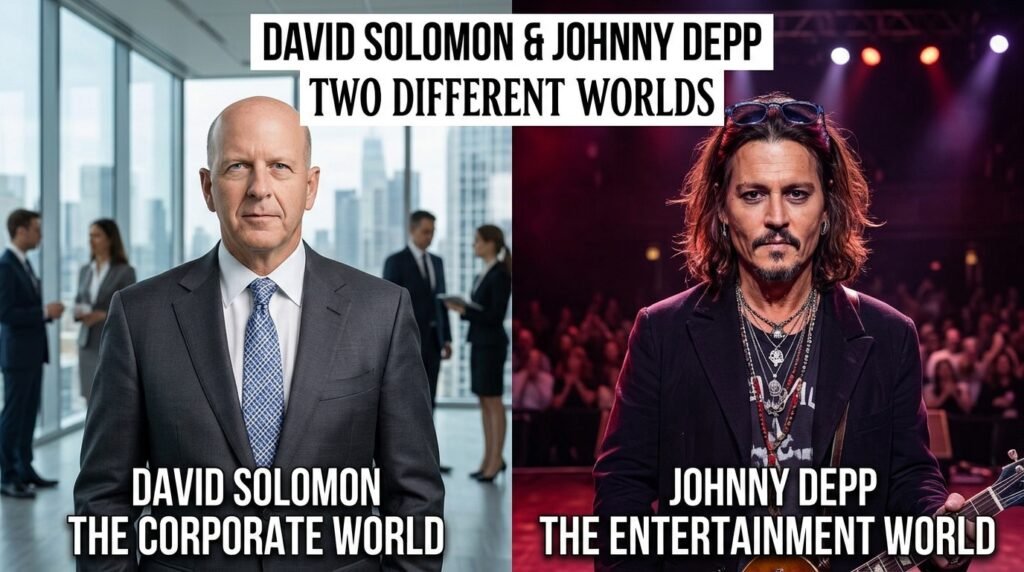

When people search for David Solomon and Johnny Depp, they may wonder what connects a powerful Wall Street executive with one of Hollywood’s most recognizable actors. At first glance, their careers appear to have little in common. One operates in global finance, where business strategy, investment decisions, and economic trends shape success. The other has spent decades entertaining audiences through memorable film performances and unconventional characters. Yet both illustrate how individuals can build influential public profiles in very different industries.
David Solomon and Johnny Depp represent two distinct approaches to professional success. Solomon is known for his leadership at Goldman Sachs, one of the most prominent financial institutions in the world. Depp is celebrated for his versatility as an actor, particularly his portrayal of Captain Jack Sparrow in the Pirates of the Caribbean franchise. Their careers reveal different ways to develop expertise, maintain public recognition, and navigate professional challenges.
Understanding their backgrounds also helps explain why people may encounter their names in searches about influential personalities, celebrity culture, business leadership, and wealth. This article explores their biographies, major achievements, leadership styles, public images, and professional legacies. It also examines whether the two have a documented connection and what their contrasting careers can teach readers about ambition, reputation, and long-term success.
Who Are David Solomon and Johnny Depp?
David Solomon and Johnny Depp are prominent figures in separate professional fields. Solomon is a financial executive associated with corporate leadership and investment banking, while Depp is an American actor and musician known for distinctive performances.
Their public identities developed through different paths, but both have become widely recognized names.
David Solomon: A Leader in Global Finance
David Solomon is an American business executive who serves as chairman and chief executive officer of Goldman Sachs. He became CEO in October 2018 and chairman in January 2019.
Born in 1962, Solomon studied political science at Hamilton College. His career developed through several financial institutions before he joined Goldman Sachs as a partner in 1999. He subsequently held senior positions, including global head of the Financing Group and co-head of the Investment Banking Division.
His appointment to the company’s highest leadership positions reflected years of experience in financial services, client relationships, and organizational management.
As a major banking executive, Solomon works in an environment shaped by financial markets, corporate clients, regulation, investor expectations, and economic uncertainty. His responsibilities differ considerably from those of a film actor because his professional decisions affect an organization operating across numerous financial businesses.
Johnny Depp: A Distinctive Hollywood Performer
Johnny Depp, born John Christopher Depp II on June 9, 1963, in Owensboro, Kentucky, became famous through television and film.
He initially pursued music before developing an acting career. His early film appearance came in A Nightmare on Elm Street in 1984, and his role in the television series 21 Jump Street helped introduce him to a much wider audience.
Depp later established himself as an actor willing to take on unconventional roles. His performances in Edward Scissorhands, What’s Eating Gilbert Grape, and Finding Neverland demonstrated a range that extended beyond conventional leading-man characters.
His portrayal of Captain Jack Sparrow in Pirates of the Caribbean: The Curse of the Black Pearl in 2003 became one of the defining roles of his career. The character’s unusual mannerisms, humor, and unpredictable personality helped make the franchise internationally successful.
How Did David Solomon Build His Career?
David Solomon’s professional journey demonstrates the importance of industry knowledge, relationship management, and experience within complex organizations.
From Early Financial Roles to Goldman Sachs
Before joining Goldman Sachs, Solomon worked at financial institutions including Irving Trust, Drexel Burnham Lambert, and Bear Stearns. These positions provided experience in the financial services industry before he took on greater responsibilities at Goldman Sachs.
He joined Goldman Sachs in 1999 and progressed through senior investment banking positions.
His career path highlights an important distinction between professional visibility and professional influence. A senior financial executive may not have the same household-name recognition as a film star, but the executive’s decisions can have substantial consequences for employees, clients, shareholders, and corporate strategy.
Becoming CEO and Chairman
Solomon became CEO during a period when financial institutions faced changing customer expectations, technological developments, regulatory demands, and competition from new financial service providers.
His leadership has involved balancing several priorities:
- Maintaining strong relationships with institutional and corporate clients.
- Managing financial and operational risks.
- Developing business strategies across different divisions.
- Responding to changing market conditions.
- Supporting technology and operational improvements.
- Communicating with employees, investors, and other stakeholders.
These responsibilities require judgment rather than simply technical financial knowledge. A successful executive must evaluate incomplete information, understand potential risks, and make decisions whose results may not become apparent immediately.
An important insight from Solomon’s career is that leadership often depends on managing trade-offs. Growth may create opportunities but also introduce risks. Cost reductions may improve efficiency but affect morale or long-term capabilities. Effective leadership requires weighing these competing outcomes instead of pursuing a single objective.
How Did Johnny Depp Become an International Star?
Johnny Depp followed a different route to recognition, building his reputation through acting choices, memorable characters, and collaborations with filmmakers.
Early Success and Unconventional Roles
Depp attracted attention through 21 Jump Street, which established him as a recognizable television performer. However, he became particularly interested in roles that allowed him to move beyond a conventional teen-idol image.
His subsequent film work included characters with unusual personalities, emotional complexity, and distinctive appearances.
In Edward Scissorhands, for example, Depp portrayed an isolated character whose artificial hands and gentle nature created a contrast between appearance and personality. The performance helped establish his association with imaginative, unconventional cinema.
Other films demonstrated different aspects of his acting. What’s Eating Gilbert Grape explored family responsibility and emotional conflict, while Finding Neverland presented him in a more restrained dramatic role.
These performances contributed to a career built around variety rather than a single screen persona.
The Lasting Impact of Captain Jack Sparrow
Depp’s role as Captain Jack Sparrow brought his work to an enormous international audience.
The character’s distinctive speech, exaggerated gestures, comic timing, and apparent unpredictability helped differentiate him from traditional adventure-film heroes. Instead of playing a straightforward action protagonist, Depp created a character whose weaknesses and eccentricities were part of his appeal.
The success of the first Pirates of the Caribbean film led to further installments and strengthened Depp’s association with the franchise.
This achievement offers another useful insight: a memorable professional identity can become a major asset when it combines originality with audience appeal. In Depp’s case, a distinctive character helped a large entertainment franchise establish a recognizable personality.
However, success built around a famous role can also create expectations. Audiences may repeatedly associate an actor with one character, making it challenging to separate the performer from the role or to introduce a completely different screen identity.
David Solomon vs. Johnny Depp: Key Differences
Although both men have achieved professional recognition, their work environments, responsibilities, and measures of success are fundamentally different.
| Category | David Solomon | Johnny Depp |
|---|---|---|
| Primary profession | Financial executive | Actor and musician |
| Main industry | Banking and financial services | Film and entertainment |
| Best-known association | Goldman Sachs leadership | Captain Jack Sparrow |
| Core professional skills | Strategy, financial judgment, management | Acting, character development, performance |
| Main audience or stakeholders | Clients, employees, investors, regulators | Audiences, filmmakers, studios |
| Typical measures of success | Business performance, risk management, organizational results | Performances, audience response, professional recognition |
| Main professional challenge | Navigating complex markets and business priorities | Sustaining a creative career and adapting to changing opportunities |
The comparison shows why their careers should not be judged using identical standards.
Solomon’s effectiveness is connected to organizational performance and the decisions he makes as an executive. Depp’s achievements are more closely associated with performances, creative choices, and the lasting cultural influence of his work.
Both professions demand preparation and adaptability, but the practical application of those qualities differs considerably.
Do David Solomon and Johnny Depp Have a Direct Connection?
A common question about David Solomon and Johnny Depp is whether they have worked together, share a business venture, or have a personal relationship.
There is no widely established public evidence of a significant direct professional partnership between them.
Their names may appear together in online searches because both are prominent Americans whose careers attract public interest. Search engines can associate people from unrelated industries through shared discussions about wealth, influence, success, or well-known personalities.
However, appearing in the same search results does not establish a personal connection.
It is useful to distinguish three different possibilities:
- A verified professional relationship: Evidence would include a documented collaboration, shared project, or official business announcement.
- An indirect industry connection: Their professional activities may intersect with the same broader economic or entertainment environment without either person working directly with the other.
- A search-based association: Their names appear together because readers are curious about both individuals or because online content discusses them in the same context.
Without reliable documentation, it would be misleading to claim that Solomon and Depp are friends, business partners, or collaborators.
This distinction matters because celebrity and business searches can sometimes encourage speculation. A careful account separates established facts from assumptions rather than treating every online association as evidence of a relationship.
Public Image and Professional Challenges
Public reputation plays a role in both men’s careers, although it operates differently in finance and entertainment.
David Solomon’s Executive Reputation
As the head of a major financial institution, Solomon is evaluated in the context of corporate strategy, business performance, risk, and leadership.
Financial executives face scrutiny from investors, employees, regulators, clients, and the public. Their decisions can be assessed through company results, strategic direction, and their ability to respond to difficult economic conditions.
The challenge is that many business outcomes depend on factors beyond one person’s control. Interest rates, market volatility, competition, regulation, and global economic changes can all influence an institution’s performance.
Consequently, a fair assessment of an executive should consider the broader business environment rather than attributing every positive or negative result to one individual.
Johnny Depp’s Public Reputation
Depp’s public profile has been shaped by his film career, celebrity status, and personal controversies.
His highly publicized legal disputes involving his former wife, Amber Heard, attracted extensive media coverage, particularly during the 2022 defamation trials in the United States and the United Kingdom. These proceedings were legally distinct and had different outcomes.
The controversy also demonstrated how personal disputes involving famous people can influence public perceptions and professional opportunities.
For readers evaluating Depp’s career, it is important to distinguish his acting achievements from legal proceedings and media commentary. A balanced discussion should avoid treating allegations, court findings, and public speculation as interchangeable.
The broader lesson is that reputation can affect professional life, but public narratives do not always capture the full complexity of a person’s work or circumstances.
What Can Readers Learn From Their Different Careers?
The professional experiences of Solomon and Depp offer several useful lessons for people pursuing careers in business, entertainment, or other competitive industries.
1. Develop Skills Before Chasing Recognition
Solomon progressed through increasingly senior financial roles before becoming CEO. Depp built his acting career through early projects and a succession of performances.
Their paths illustrate the value of developing relevant skills rather than expecting recognition to arrive immediately.
For someone building a career, this means investing in practical experience, learning from feedback, and improving the abilities required for the next stage.
2. Build a Distinctive Professional Identity
Solomon became associated with financial leadership and organizational strategy. Depp became recognized for distinctive character performances.
A strong professional identity helps people understand what someone contributes and why that contribution matters.
This principle applies to entrepreneurs, writers, consultants, and creators. Consistency is useful, but differentiation also matters. People need a clear reason to remember your work.
3. Adapt When Circumstances Change
Financial markets evolve, business models shift, and customer expectations change. Entertainment careers also develop as audience preferences, production methods, and opportunities change.
Long-term success often requires adjusting strategies without abandoning core strengths.
For example, a business owner may need to adopt new technology, while a creative professional may need to explore different roles or formats. In either case, adaptability works best when it builds on existing expertise.
4. Separate Publicity From Lasting Achievement
High visibility does not necessarily mean someone is effective at their profession. Likewise, limited public recognition does not mean a person’s work lacks value.
Solomon’s work is primarily evaluated through financial leadership, while Depp’s performances are assessed through artistic and audience responses.
A useful approach is to identify the actual criteria that matter in a field before evaluating an individual’s success.
Frequently Asked Questions
1. Who is David Solomon?
David Solomon is an American financial executive known for leading Goldman Sachs as its chairman and CEO. He joined the firm as a partner in 1999 after working at other financial institutions. His career has included senior investment banking and financing roles. He studied political science at Hamilton College.
2. Why is Johnny Depp famous?
Johnny Depp is an American actor and musician known for playing distinctive characters across a wide range of films. His best-known roles include Captain Jack Sparrow in Pirates of the Caribbean and Edward Scissorhands in the film of the same name. His performances often combine unusual character choices with dramatic or comedic elements. He has also received multiple Academy Award nominations.
3. Are David Solomon and Johnny Depp friends?
There is no widely documented public evidence establishing a personal friendship between David Solomon and Johnny Depp. They work in different professional industries and are known for different achievements. Their names appearing together in search results does not demonstrate a personal relationship. Claims about a friendship would require reliable supporting evidence.
4. Do David Solomon and Johnny Depp work in the same industry?
No, they are associated with different industries. Solomon works in financial services and corporate leadership, while Depp works primarily in film and entertainment. Their professional responsibilities and measures of success differ substantially. Both, however, have developed recognizable public profiles through years of work in their respective fields.
5. Who is more successful, David Solomon or Johnny Depp?
There is no objective answer because success depends on the criteria being used. Solomon’s career can be assessed through executive responsibilities, business strategy, and financial leadership. Depp’s career can be evaluated through acting performances, professional recognition, and cultural impact. Comparing them fairly requires recognizing that they pursue different goals.
6. What connects David Solomon and Johnny Depp?
The most evident connection is their status as prominent public figures, not a confirmed personal or professional partnership. Solomon is known for his leadership in global finance, while Depp is recognized for his contribution to cinema. They may be discussed together in content about successful or influential personalities. Any more specific connection should be supported by verifiable evidence.
Conclusion
David Solomon and Johnny Depp demonstrate how professional success can take very different forms. Solomon built a career in financial services and rose to the highest leadership positions at Goldman Sachs. Depp developed an international acting career through distinctive performances, memorable characters, and major film projects.
Their stories offer complementary lessons about expertise, professional identity, adaptability, and reputation. Business leadership requires balancing competing priorities and managing uncertainty, while acting requires creative interpretation, preparation, and the ability to connect with audiences.
There is no widely established evidence of a significant direct relationship between the two, so their similarities should not be mistaken for a shared professional history.
Ultimately, the most useful way to understand David Solomon and Johnny Depp is to examine what each has accomplished within his own field. Their contrasting careers show that there is no single formula for success: lasting achievement depends on developing valuable skills, responding to challenges, and making meaningful contributions in the work a person chooses to pursue.