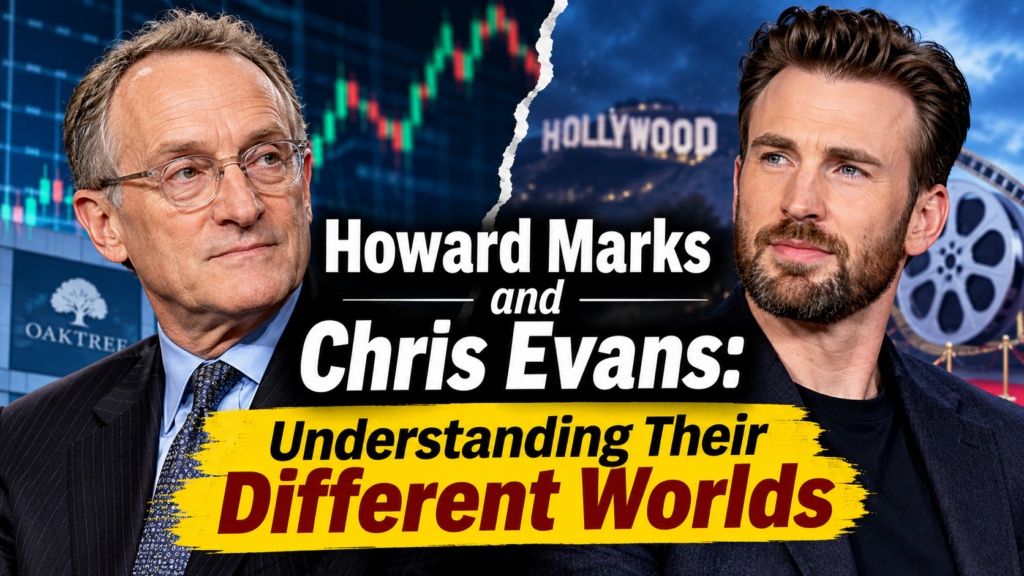

When two well-known people share a search query, it is natural to wonder whether they have a personal connection, a professional relationship, or simply something in common that has attracted public attention. The topic of Howard Marks and Chris Evans is an interesting example because both names can refer to prominent public figures, but they are associated with very different fields. Howard Marks is best known in the financial world as the co-founder of Oaktree Capital Management and for his thoughtful writing about investment risk. Chris Evans, meanwhile, is widely recognized as an American actor, particularly for portraying Steve Rogers, also known as Captain America, in Marvel films.
Their careers illustrate two different forms of public influence. One is associated with investment decisions, financial cycles, and the management of capital; the other is associated with storytelling, performance, and popular culture. Understanding the people behind these names helps clarify what makes each notable, why their work attracts attention, and what readers can learn from their professional journeys.
This article explores their backgrounds, achievements, working philosophies, and public reputations. It also addresses an important distinction: a shared search phrase does not, by itself, establish that two people know each other or have collaborated. Separating documented facts from assumptions is essential when researching public figures.
Who Is Howard Marks?
Howard Marks is an American investor, author, and financial thinker best known for co-founding Oaktree Capital Management in 1995. His professional career has focused on investment management, particularly credit markets, high-yield bonds, and distressed debt. He is respected for explaining how investors can evaluate risk, recognize market extremes, and make more disciplined decisions.
Early Career and Education
Marks studied economics and finance at the Wharton School of the University of Pennsylvania, graduating with honors. He later earned an MBA in accounting and marketing from the University of Chicago Booth School of Business. His education provided a foundation for a career that combined financial analysis with business judgment.
He began working in investment management in 1969 at Citicorp. Over the following years, he gained experience in equity research and eventually took on senior responsibilities involving convertible securities and high-yield investments.
In 1985, Marks moved to TCW Group, where he led investment activities involving distressed debt, high-yield bonds, and convertible securities. These areas require investors to assess not only a company’s potential but also its ability to meet financial obligations under difficult circumstances.
His experience helped prepare him for the next major step in his career: establishing Oaktree Capital Management with a group of investment professionals.
Building Oaktree Capital Management
Oaktree was founded in 1995 and developed a reputation for its focus on credit investing and a disciplined approach to risk. Marks became one of its leading figures, helping establish the principles that guided the firm’s investment decisions.
Distressed debt involves investing in the debt of companies experiencing serious financial difficulties. Such investments can offer opportunities, but they also carry substantial risks. Investors must carefully evaluate a company’s financial position, the value of its assets, the likelihood of restructuring, and the possibility of losing money.
Marks’s approach emphasizes understanding what can go wrong rather than concentrating exclusively on possible gains.
His career demonstrates an important lesson for anyone studying business: expertise is not simply about identifying opportunities. It also involves recognizing when the potential reward does not justify the risk.
Howard Marks’s Investment Philosophy
Marks is particularly associated with the idea that successful investing requires more than predicting the future. Investors must also understand uncertainty, market psychology, and the relationship between price and value.
Three principles are especially relevant to his philosophy.
- Risk management matters: An investment that promises attractive returns may still be unsuitable if the potential downside is too severe.
- Market cycles influence decisions: Periods of widespread optimism can encourage excessive risk-taking, while fear can create opportunities for investors who remain disciplined.
- Independent thinking is valuable: Investors should examine evidence rather than automatically following popular opinions.
These principles do not eliminate investment losses. Instead, they provide a framework for making more thoughtful decisions when outcomes are uncertain.
For individual investors, the practical lesson is to consider what an investment could lose, not just what it might earn. This is especially important when markets are rising rapidly and confidence becomes widespread.
Books and Writings
Marks is also known for his investment memos and books, which explain complex financial concepts in accessible language.
His best-known book, The Most Important Thing: Uncommon Sense for the Thoughtful Investor, explores risk, market behavior, and the importance of second-level thinking. The latter means looking beyond the obvious interpretation of a situation and considering how other investors may respond.
His book Mastering the Market Cycle: Getting the Odds on Your Side examines how market conditions change and why investor behavior often shifts between excessive optimism and excessive pessimism.
These writings appeal to readers who want to understand the reasoning behind investment decisions rather than simply receive stock tips.
An important distinction is that Marks’s ideas are educational frameworks, not guarantees of investment success. Applying them requires independent research, an understanding of personal financial circumstances, and appropriate consideration of risk.
Who Is Chris Evans?
Chris Evans is an American actor best known internationally for playing Steve Rogers, or Captain America, in the Marvel Cinematic Universe. His career includes superhero films, dramatic performances, romantic comedies, and work behind the camera.
Born Christopher Robert Evans on June 13, 1981, in Boston, Massachusetts, he developed an interest in acting before becoming a major Hollywood star. His success reflects years of professional development, a range of roles, and a particularly influential part in one of the most recognizable film franchises of the modern era.
Early Acting Career
Evans began gaining attention through television and film roles in the early 2000s. One of his early major film appearances was in the teen comedy Not Another Teen Movie, released in 2001.
He subsequently appeared in films that helped him establish himself as a young actor capable of working across different genres. Before his defining Marvel role, he played Johnny Storm, also known as the Human Torch, in Fantastic Four (2005) and Fantastic Four: Rise of the Silver Surfer (2007).
These projects gave Evans experience with large-scale productions and action-oriented performances. However, they also illustrate why an actor’s career should not be judged by one role alone. Building a sustainable career often requires trying different characters and learning how to adapt to changing audience expectations.
Becoming Captain America
Evans’s career reached a new level of international recognition when he appeared as Captain America in Captain America: The First Avenger (2011).
His portrayal continued through major Marvel films, including The Avengers (2012), Captain America: The Winter Soldier (2014), Captain America: Civil War (2016), Avengers: Infinity War (2018), and Avengers: Endgame (2019).
The character’s appeal comes partly from the contrast between physical strength and personal integrity. Steve Rogers is portrayed as someone whose defining qualities include courage, loyalty, and a willingness to stand up for others.
Evans’s performance helped establish a consistent personality across a series of interconnected films. Maintaining that consistency is a demanding task because each film must serve its own story while contributing to a much larger fictional universe.
One useful insight from Evans’s career is that a recognizable role can become both an advantage and a limitation. A famous character introduces an actor to a global audience, but it can also shape how audiences perceive the actor’s other work.
Chris Evans Beyond Marvel
Evans has demonstrated an interest in projects outside the superhero genre. His film credits include Snowpiercer (2013), Gifted (2017), and Knives Out (2019).
These roles offer a different view of his abilities. Rather than relying primarily on action sequences, they require performances shaped by character relationships, emotional tension, humor, or moral conflict.
He also made his directorial debut with Before We Go (2014), a romantic drama in which he starred. This move demonstrated an interest in storytelling beyond acting alone.
His broader career illustrates why performers benefit from developing skills and choosing projects that challenge established expectations. Commercial success can provide opportunities, but creative range can help an actor build a more varied body of work.
Howard Marks and Chris Evans Compared
Howard Marks and Chris Evans work in different industries, so a direct comparison of their professional achievements must account for their distinct goals.
A comparison of their careers and areas of influence
| Category | Howard Marks | Chris Evans |
|---|---|---|
| Primary profession | Investor and author | Actor and filmmaker |
| Main industry | Finance and investment management | Film and entertainment |
| Best known for | Oaktree Capital Management and investment philosophy | Captain America and other film roles |
| Core professional skill | Financial analysis and risk assessment | Acting and character development |
| Public influence | Investors, business leaders, and financial readers | Film audiences and popular culture |
| Long-term contribution | Investment insights and financial education | Performances and contributions to filmmaking |
The most important difference is how their work creates value. Marks evaluates financial opportunities and helps manage investment strategies. Evans interprets characters and helps bring stories to life.
Nevertheless, their careers offer several useful parallels.
Both Built Recognition Over Time
Neither professional identity is explained entirely by a single achievement. Marks developed expertise through decades of financial work, while Evans built his acting career through a succession of roles before becoming globally associated with Captain America.
Their journeys illustrate the value of sustained development rather than expecting immediate recognition.
Both Operate in Competitive Environments
Investment management involves uncertainty, changing economic conditions, and competition for attractive opportunities. Acting involves auditions, unpredictable production schedules, changing audience tastes, and competition for roles.
The pressures differ, but both fields reward preparation, judgment, and the ability to adapt.
Their Influence Extends Beyond Their Main Jobs
Marks shares investment ideas through books and memos, helping readers understand risk and market behavior. Evans has expanded beyond acting into directing and other creative activities.
In both cases, professional influence can grow when people communicate their knowledge or explore responsibilities beyond their original role.
A Different Howard Marks and Chris Evans Connection: Technology
There is another important detail when researching this topic: Howard Marks and Chris Evans also refer to two technology professionals who have a documented professional connection. This is distinct from the American investor and Hollywood actor discussed above.
In the technology industry, Howard Marks is known for his work as a storage analyst, consultant, and technology writer. Chris Evans is a British IT specialist, consultant, and technology writer associated with the Storage Unpacked podcast.
The two appeared together in technology-industry discussions, including a 2017 storage industry event. In June 2019, Evans also interviewed Marks in a Storage Unpacked episode about VAST Data, where Marks was working as Chief Storyteller.
This is a meaningful distinction because it provides a documented reason that the two names may appear together in search results.
What Did Their Technology Interview Cover?
The conversation focused on enterprise data storage, VAST Data’s technology, and Marks’s professional experience.
Enterprise storage refers to systems that organizations use to store, protect, access, and manage large amounts of information. Businesses rely on these systems for applications, databases, analytics, and other essential operations.
Topics associated with their discussion included:
- Storage architecture and how storage systems are designed.
- Hardware technologies used in modern data infrastructure.
- Data protection and the challenges of managing business information.
- VAST Data’s approach to building scalable storage systems.
- Marks’s experience in technology analysis and consulting.
The interview is an example of how technology specialists share expertise through industry podcasts. Rather than discussing celebrity news, the conversation explored a technical business subject for an audience interested in enterprise IT.
Why This Connection Matters for Search Intent
When someone searches for Howard Marks and Chris Evans, the intended answer may depend on which people they mean. The technology connection is particularly relevant if the search originated from a podcast, a storage conference, or an enterprise technology article.
A useful way to identify the correct individuals is to look for these clues:
- References to Oaktree Capital Management point to the American investor Howard Marks.
- References to Marvel films and Captain America point to the American actor Chris Evans.
- References to VAST Data, storage architecture, and Storage Unpacked point to the technology professionals.
- References to Mr Nice point to the Welsh author Dennis Howard Marks.
Recognizing these differences makes the search more precise and prevents information about unrelated people from being combined.
Frequently Asked Questions
1. Are Howard Marks and Chris Evans connected?
The answer depends on the individuals intended. The technology analyst Howard Marks and British technology professional Chris Evans have a documented professional connection through industry events and a podcast interview. No comparable connection has been established here between the Oaktree investor and the American actor.
2. Which Chris Evans interviewed Howard Marks?
The interviewer was Chris Evans, the British technology specialist associated with the Storage Unpacked podcast. He is a different person from the American actor who portrayed Captain America.
3. What is Howard Marks known for in technology?
The technology professional Howard Marks is known for storage analysis, consulting, writing, and work associated with VAST Data. His technology career is separate from that of the American investor who co-founded Oaktree Capital Management.
4. What is the connection between Howard Marks and VAST Data?
The technology analyst Howard Marks worked as Chief Storyteller at VAST Data. His role involved communicating the company’s technology story, which was the subject of his discussion with Chris Evans on Storage Unpacked.
5. Is the Howard Marks who founded Oaktree the same person?
No. Howard Stanley Marks, the investor and Oaktree co-founder, is a different person from the technology analyst Howard Marks. Their professional backgrounds belong to separate industries, so their biographies should not be mixed.
6. Why is identifying the correct Chris Evans important?
Chris Evans is a shared name associated with several public figures, including an American actor and a British broadcaster and technology professional. Checking the person’s occupation and the surrounding context helps ensure that information about the right individual is used.
Conclusion
The search phrase Howard Marks and Chris Evans can refer to more than one pair of public figures. The best-known names include an American investor and a Hollywood actor, but a documented professional connection also exists between a technology analyst named Howard Marks and British technology specialist Chris Evans.
The technology connection centers on industry events and a Storage Unpacked interview about VAST Data and enterprise storage. This provides a concrete explanation for why the names appear together in technology-related searches.
The key takeaway is to establish each person’s identity before drawing conclusions about their relationship. Whether the interest is finance, entertainment, or technology, distinguishing between people with the same names leads to more accurate and useful research